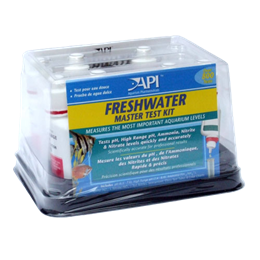
This test kit measures KH in dKH (where one dKH = 17.8 ppm as CaCO3). A minimum KH level of at least 4 dKH is advised. and a KH of between 6 and 8 dKH is more desirable for most domestically kept tropical fish.
- Ensure the test tube is clean.
- Take a 5 ml sample of water into the test tube.
- Take the KH reagent and add one drop, mix and the water sample should turn pale blue.
- Keep adding drops, one by one (remember to count the drops), mixing between drops, until the blue colour turns to yellow.
- Write down the number of drops, including the first drop, needed to bring about the colour change this is equal to the KH value in dKH.
- Should the first drop of reagent turn the sample yellow then the KH value is below 1 dKH - this is extremely dangerous for fish.
Check the KH level of your tap water. If the level is above 6 dKH, then regular water changes should keep the KH value in the aquarium topped up at a reasonable level. If the KH value of your tap water is below 6 dKH, you may choose to add a KH buffer,
This test kit measures GH in dGH (where one degree = 17.8 ppm as CaCO3). The correct GH depends on the type of fish being kept. For soft water species, aim for a GH of around 3 to 6 dGH, while for hard water species, 10 to 15 dGH is the correct range.
- Ensure the test tube is clean.
- Take a 5 ml sample of water into the test tube.
- ke the GH A reagent and add two drops.
- Mix and the water sample should turn dark pink. Adding one drop of reagent GH B at a time, mixing between drops, count the number of drops required for the solution to change from pink to blue.
- The number of drops needed to bring about the colour change is equal to the GH value in dGH. Should the first drop of GH B reagent turn the sample blue then the GH value is below 1 dGH and indicates very soft water.
Test the GH of your tap water. The GH of tap water is determined by whether you live in a hard or soft water area. If the water is too hard for the fish being kept, alternative water can be used or mixed with the tap water such as reverse osmosis water as this will lower the GH. To increase the GH for aquarium fish, calcium carbonate rocks (like ocean rock) or coral gravel can be used to provide a continual source of GH minerals.
Raising or lowering of the waters hardness will affect the pH so if you do either, do it slowly over a minimum 24-hour period.
- Orders to £49 will be charged £4.95 for delivery - Royal Mail
- Orders over £49 include free standard delivery - Royal Mail or APC depending on value and postcode.
- Exception to free delivery is frozen food as this requires bespoke packaging and a next day service, usually APC, but also Royal Mail to some postcodes
- If ordering frozen food, you can add dry goods of any value with out additional delivery fees.
- We cannot ship perishable goods to Scottish Islands, Isle of Man, Jersey, Guernsey or Northern Ireland - or the following postcodes AB37-38, AB41-56, FK19-21, HS1-9, KA27-28, IV1-20, IV21-63, KW1-18, PA20,21,23-35 36-78, PH15-27,30-45,49-50, ZE1-3
- If in doubt please call 01323 483689 for clarification, or devotedlydiscus@gmail.com
- If collecting goods from shop, please call 01323 483689 to check availabilty reserve stock.